SEVEN
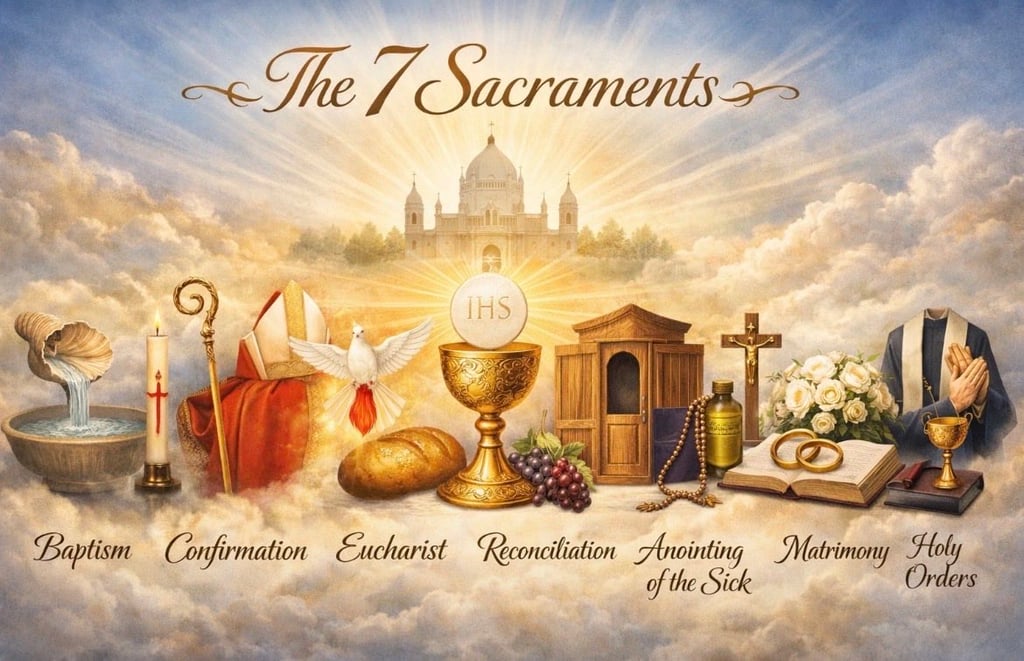
There are Seven Sacraments of the Catholic Church.
The seven sacraments
Baptism — entry into the Christian life; cleansing from original sin.
Confirmation — strengthening by the Holy Spirit; completion of baptismal grace.
Eucharist — receiving the Body and Blood of Christ; the central sacrament of Catholic worship.
Penance (Reconciliation / Confession) — forgiveness of sins through absolution.
Anointing of the Sick — spiritual and sometimes physical healing; grace in illness or near death.
Holy Orders — ordination of deacons, priests, and bishops.
Matrimony — sacramental marriage between spouses.
While most animals entered the ark in pairs, Noah was instructed to bring seven pairs of every clean animal and bird. What was their primary purpose after the flood?
Answer: To provide for sacrifice (and later, food).
Genesis 7:2–3; Genesis 8:20
2. This sacred object inside the tabernacle bore seven lights and symbolized God’s presence among His people. What was it?
Answer: The golden lampstand (menorah)
Exodus 25:31–37
3. On the Day of Atonement, the high priest entered the Most Holy Place and used his finger to perform this specific action seven times against the front of the mercy seat. What was this ritual act?
Answer: Sprinkling the blood of the bull and goat
Leviticus 16:14–15
4. This fortified city fell only after Israel marched around it once each day for six days, then seven times on the seventh day, with seven priests carrying seven trumpets of rams’ horns and a great shout. What city was it?
Answer: Jericho
Joshua 6:3–5; Joshua 6:15–20
5. After the prophet Elisha stretched himself out over the body of a Shunammite woman’s dead son, what specific physical reaction occurred seven times to signal the boy had returned to life?
Answer: He sneezed seven times
2 Kings 4:35
6. In Proverbs, wisdom is personified as a woman who has built her house and set it on seven ___________?
Answer: Pillars
Proverbs 9:1
7. Isaiah describes the Spirit of the LORD resting upon the Messiah with seven distinct attributes. What does this sevenfold description represent?
Answer: The fullness of the Spirit of the LORD
Isaiah 11:1-3
8. When Peter suggested forgiving a brother seven times, Jesus replied with this hyperbolic multiplier to indicate limitless forgiveness. What was the multiplier?
Answer: Seventy (seventy times seven)
Matthew 18:21–22
9. Jesus cast seven demons out of this woman, who later became one of the first witnesses to His resurrection. Who was she?
Answer: Mary Magdalene
Luke 8:2; Mark 16:9
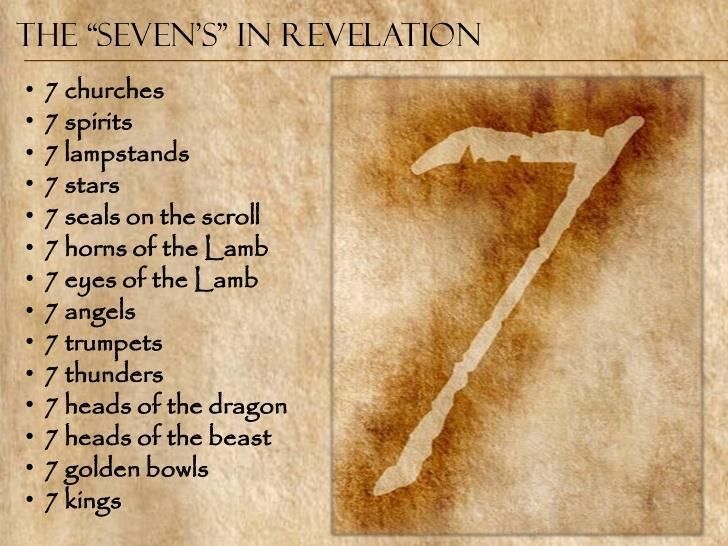
10. After the seven seals are opened in Revelation, another series of seven announces escalating judgments through loud blasts heard across heaven and earth. What are these seven called?
Answer: The seven trumpets
Revelation 8:2–6
In the book of Proverbs, a list is given of six things the LORD hates, followed by a seventh that is described as an “abomination to Him.” What is the seventh thing on this list?
Answer: One who sows discord among brothers
Proverbs 6:16–19.
⭐ 1. Biblical Israel (Jacob) and the Number 77
Jacob/Israel is 77 years old at a pivotal moment
According to traditional Jewish chronology:
Jacob (Israel) was 77 years old when he fled to Laban and began the sequence that leads to the birth of the Twelve Tribes of Israel.
This makes 77 a foundational age in the formation of “Israel” as a people.
⭐ 2. “Seventy times seven” — Forgiveness and Covenant Logic
In the Hebrew Bible:
Lamech vows vengeance 77-fold (Genesis 4:24).
Jesus later inverts this with “seventy times seven” (Matthew 18:22), restoring covenantal mercy.
This creates a 77 ↔ Israel axis around:
covenant
transgression
restoration
A pattern that recurs in Jewish history.
NASB: Tobit 14:3 — “Tobiah’s seven sons” (Son of Tobit)
The NASB explicitly states:
“As he was dying, he summoned his son Tobiah and Tobiah’s seven sons…”
In Tobit, his son Tobias marries Sarah, who has previously had 7 dead husbands
The “sevens” (Sarah’s seven dead husbands and the son of Tobit , Tobias seven sons) are not random. They form a double‑symbol of fullness, completion, and oath‑level divine intervention, preparing for the moment when God breaks the cycle through Raphael, whose name means “God heals.”
🜁 1. Sarah’s Seven Husbands — Fullness of affliction
Sarah (Tobit 3–7) has had seven husbands, each killed by the demon Asmodeus on their wedding night.
Symbolically, this expresses:
Totality of suffering — seven deaths = suffering brought to its “full measure.”
Completion of human failure — no human man can break the curse.
Threshold moment — in biblical symbolism, when “seven” is reached, God acts.
Sarah’s sevenfold tragedy becomes the precondition for divine intervention:
Raphael is sent only after the seventh death.
🜁 2. Tobit’s son Tobias has Seven Sons with Sarah— Fullness of blessing
Symbolically:
Full household — seven sons = complete family strength.
Full covenantal fruitfulness — seven = oath, covenant, divine satisfaction.
Mirroring Sarah — her seven losses are balanced by her seven sons with Tobias.
Tobias (Tobit's son) is effectively the eighth husband, the one who breaks the cycle.
1 Samuel 2:5 (ESV)
Those who were full have hired themselves out for bread,
but those who were hungry have ceased to hunger.
The barren has borne seven,
but she who has many children is forlorn.
Jeremiah 15:9 (ESV)
She who bore seven has grown feeble,
she has fainted away;
her sun went down while it was yet day;
she has been shamed and disgraced.
And the rest of them I will give to the sword
before their enemies, declares the LORD.”
Luke 3:21–38 (D-R)
21 Now it came to pass, when all the people were baptized, that Jesus also being baptized and praying, heaven was opened.
22 And the Holy Ghost descended in a bodily shape, as a dove, upon him. And a voice came from heaven: Thou art my beloved Son. In thee I am well pleased.
23 And Jesus himself was beginning about the age of thirty years: being (as it was supposed) the son of Joseph, who was of Heli, who was of Mathat,
24 Who was of Levi, who was of Melchi. who was of Janne, who was of Joseph,
25 Who was of Mathathias, who was of Amos, who was of Nahum, who was of Hesli, who was of Nagge,
26 Who was of Mahath, who was of Mathathias, who was of Semei, who was of Joseph, who was of Juda,
27 Who was of Joanna, who was of Reza, who was of Zorobabel, who was of Salathiel, who was of Neri,
28 Who was of Melchi, who was of Addi, who was of Cosan, who was of Helmadan, who was of Her,
29 Who was of Jesus, who was of Eliezer, who was of Jorim, who was of Mathat, who was of Levi,
30 Who was of Simeon, who was of Judas, who was of Joseph, who was of Jona, who was of Eliakim,
31 Who was of Melea, who was of Menna, who was of Mathatha, who was of Nathan, who was of David,
32 Who was of Jesse, who was of Obed, who was of Booz, who was of Salmon, who was of Naasson,
33 Who was of Aminadab, who was of Aram, who was of Esron, who was of Phares, who was of Judas,
34 Who was of Jacob, who was of Isaac, who was of Abraham, who was of Thare, who was of Nachor,
35 Who was of Sarug, who was of Ragau, who was of Phaleg, who was of Heber, who was of Sale,
36 Who was of Cainan, who was of Arphaxad, who was of Sem, who was Of Noe, who was of Lamech,
37 Who was of Mathusale, who was of Henoch, who was of Jared, who was of Malaleel, who was of Cainan,
38 Who was of Henos, who was of Seth, who was of Adam, who was of God.
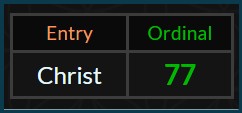
In the genealogy of Luke 3 there are exactly 77 names, with GOD at the one end, and JESUS at the other
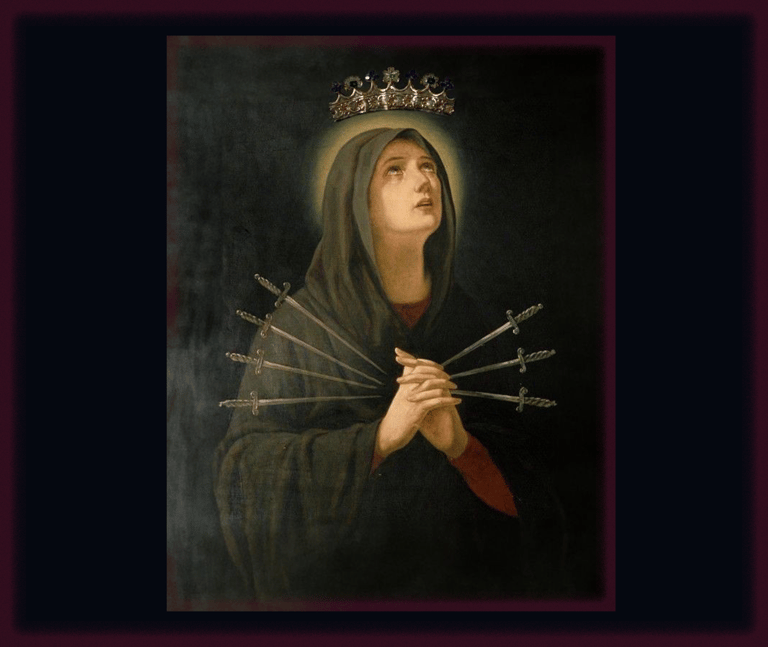
SEVEN SORROWS OF MARY
The Prophecy of Simeon – Simeon foretells that Mary’s soul will be pierced by a sword when presenting Jesus in the Temple (Luke 2:25–35).
The Flight into Egypt – Mary and Joseph flee with the infant Jesus to escape King Herod’s massacre (Matthew 2:13–15).
The Loss of the Child Jesus in the Temple – Mary and Joseph lose the 12-year-old Jesus for three days before finding Him teaching in the Temple (Luke 2:41–50).
Mary Meets Jesus on the Way to Calvary – Mary encounters her suffering Son carrying the Cross to Golgotha (Luke 23:27–31).
The Crucifixion and Death of Jesus – Mary stands at the foot of the Cross as Jesus dies (John 19:25–30).
The Body of Jesus is Placed in Mary’s Arms – After the Crucifixion, Jesus’ lifeless body is taken down and laid in His Mother’s arms (Luke 23:50–54).
The Burial of Jesus – Mary watches as her Son is laid in the tomb (Luke 23:55–56).
Seven Heavenly Virtues
Faith, Hope, Charity, Prudence, Justice, Fortitude, Temperance.
Seven Capital Sins
Pride, Greed, Lust, Envy, Gluttony, Wrath, Sloth.
The Significance of 70 in the Bible
1. A Number of Completion on a National Scale
Where 7 signals divine completeness, 70 often scales that completeness up to the level of nations, generations, or historical cycles.
70 nations listed in Genesis 10 — the “Table of Nations,” symbolising the fullness of the world’s peoples.
70 descendants of Jacob entering Egypt (Genesis 46:27) — the seed of Israel as a complete proto‑nation.
Pattern: 70 = fullness of a people or world-order.
2. A Number of Leadership and Governance
70 elders appointed to assist Moses (Numbers 11:16–17).
The later Sanhedrin was traditionally composed of 70 elders.
Pattern: 70 = complete council, full authority, legitimate governance.
3. A Number of Exile, Judgment, and Restoration
Jeremiah’s prophecy: Israel would serve 70 years in Babylon (Jeremiah 25:11–12).
Daniel’s 70 weeks (Daniel 9:24) — a prophetic framework of restoration, atonement, and consummation.
Pattern: 70 = a full cycle of judgment leading to renewal.
4. A Number of Forgiveness and Mercy
Jesus tells Peter to forgive “seventy times seven” (Matthew 18:22).
This isn’t arithmetic — it’s symbolic: forgiveness without limit.
Pattern: 70 = overflowing mercy multiplied.
5. A Number of Mission and Universal Outreach
Jesus sends out 70 disciples (Luke 10:1 in many manuscripts).
This mirrors the 70 nations of Genesis — a symbolic mission to the whole world.
Pattern: 70 = universal mission, global scope.
September 11, 2001, WTC Attacks
Jewish Calendar Day 349
The 70th Prime Number = 349
July 4, USA Independence Day.
September 11, 2001 was 7 days before Rosh HaShanah.
Genesis TEN lists 70 [7x10] nations, and it is a symbol of fullness of people and WORLD ORDER.
70 descendants of Jacob entered EGYPT and this is a symbol of the seed of Israel .


In the Hebrew, seven is שֶׁבַע (shevah). It is from the root שָׁבַע (savah), to be full or satisfied, have enough of. Hence the meaning of the word “seven” is dominated by this root, for on the seventh day God rested from the work of Creation. It was full and complete, and good and perfect. Nothing could be added to it or taken from it without marring it. Hence the word שָׁבַת (Shavath), to cease, desist, rest, and שַׁבָּת Shabbath, Sabbath, or day of rest. This root runs through various languages; e.g., Sanscrit, saptan; Zend., hapta; Greek, ἑπτά (hepta); Latin, septem. All these preserve the “t,” which in the Semitic and Teutonic languages is dropped out; e.g. Gothic, sibun; Germ., sieben; Eng., seven.
It is seven, therefore, that stamps with perfection and completeness that in connection with which it is used. Of time, it tells of the Sabbath, and marks off the week of seven days, which, artificial as it may seem to be, is universal and immemorial in its observance amongst all nations and in all times. It tells of that eternal Sabbath-keeping which remains for the people of God in all its everlasting perfection.
In the creative works of God, seven completes the colors of the spectrum and rainbow, and satisfies in music the notes of the scale. In each of these the eighth is only a repetition of the first.
Another meaning of the root שָׁבַע (Shavagh) is to swear, or make an oath. It is clear from its first occurrence in Genesis 21:31, “They sware both of them,” that this oath was based upon the “seven ewe lambs” (Genesis 21:28–30), which point to the idea of satisfaction or fulness in an oath. It was the security, satisfaction, and fulness of the obligation, or completeness of the bond, which caused the same word to be used for both the number seven and an oath; and hence it is written, “an oath for confirmation is an end of all strife.” Beer-sheba, the well of the oath, is the standing witness of the spiritual perfection of the number seven. The number meets us on
The Fore-Front of Revelation
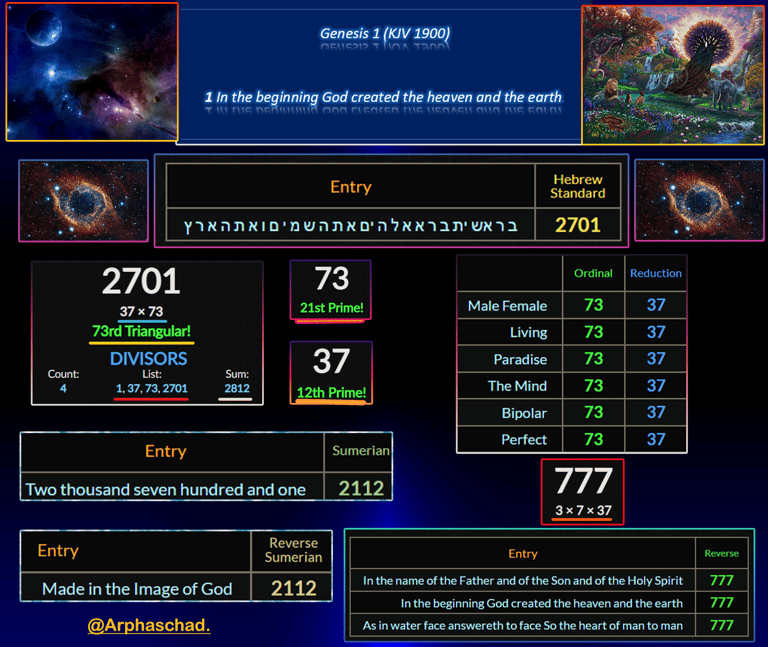
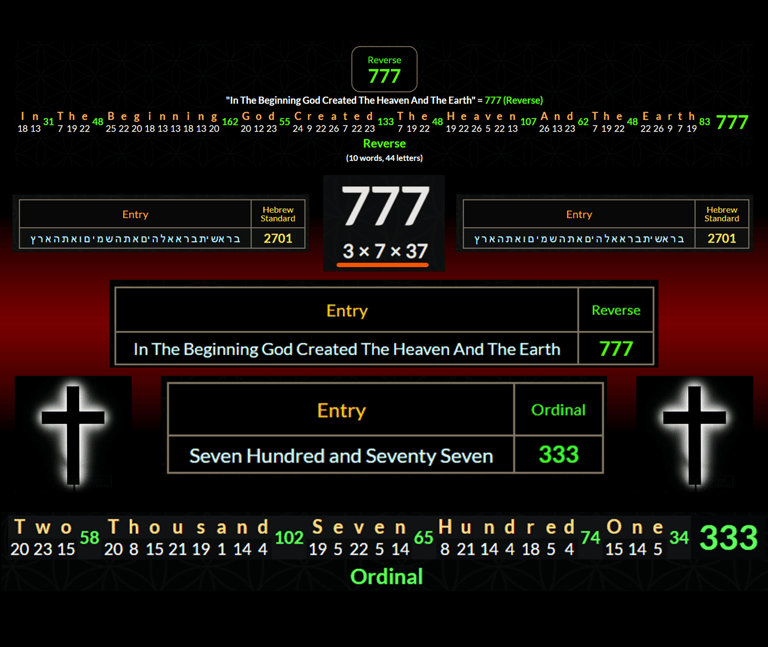
The first statement as to the original Creation in Genesis 1:1 consists of 7 words, and 28 letters (4x7).
The Words of Jehovah
are pure words. They are not angelic words (2 Corinthians 12:4; 1 Corinthians 13:1), not words pertaining to heaven; but words used by men on this earth, human words, and therefore they have to be perfectly purified, as silver is purified in a furnace. In Psalm 12:6, there is an ellipsis which requires the word “words” to be repeated from the previous clause. Then we can take the preposition ל, (Lamed), which means “to,” in its natural sense. The A.V. translates it of (“a furnace of earth”); and the R.V. renders it on (“a furnace on the earth”). Both are wrong through not seeing and supplying the ellipsis which would have enabled them to translate the ל to, or pertaining to, literally. Thus:—
a | The words of Jehovah are pure words,
b | As silver tried in a furnace:
a | [Words] pertaining to the earth,
b | Purified seven times.
Here we have the four lines complete, in which “a” corresponds to “a,” the subject being the words of Jehovah. While in “b” and “b” we have the purifying: in “b” of silver, and in “b” of the earthly words which Jehovah uses.
Jehovah takes up and uses words “pertaining to this world,” but they require purifying. Some words He does not use at all; some He uses with a higher meaning; others He uses with a new meaning: thus they are purified. Now, silver is refined “seven times.” So these words have to be perfectly purified before they can be used as “the words of Jehovah.”
Abraham’s Seven-Fold Blessing
in Genesis 12:2–3:—
“I will make of thee a great nation,
And I will bless thee,
And make thy name great;
And thou shalt be a blessing;
And I will bless them that bless thee,
And curse him that curseth thee:
And in thee shall all families of the earth be blessed.” p 170
With this we may compare
Jehovah’s Seven-Fold Covenant with Israel
in Exodus 6:6–8. Seven times does the expression, “I will” occur in these few verses, stamping the whole with spiritual perfection. These are preceded by “I have” three times repeated (Exodus 6:4–5), giving the Divine basis on which the blessing was based:—
I have established My covenant with them, etc.
I have also heard their groaning, etc.
I have remembered My covenant.
Then follows the seven-fold blessing:—
I will bring you out from Egypt.
I will rid you of their bondage.
I will redeem you.
I will take you to Me for a people.
I will be to you a God.
I will bring you in unto the land.
I will give it you.
“Now Hebron Was Built Seven Years before Zoan in Egypt”
(Numbers 13:22). Egypt was “the house of bondage.” Zoan was that city in it where its wise men were shown to be fools (Isaiah 19:11–13). It was also the place where God’s miracles were performed which brought out the folly of that human wisdom (Psalm 78:12, 43).
But Hebron, which means fellowship, was a place in Canaan, the city of Abraham, “the friend of God,” still called today the city of El Khulil, “of the Friend.” In its valley, Eschol, grew the finest fruit of Emmanuel’s land.
“Now Hebron was built seven years before Zoan in Egypt.” This phrase, thrown in parenthetically, at the moment when His people first discovered the existence of Hebron, contains the intimation of a deep spiritual truth, as shown by the significance of the number seven.
It shows that the sphere of Divine friendship and fellowship and of heavenly delights was established in eternity, seven years marking the spiritual perfection of time, before the wisdom of this world had any existence or place. (See p 171 Psalm 90:2; 103:17; Proverbs 8:22–31; Micah 5:2; John 17:5–24; 1 Corinthians 2:7; Ephesians 1:4–3:11; 2 Timothy 1:9: Titus 1:2; 1 Peter 1:19–20).
The Seven-Fold Sprinkling
implies that it was perfectly and spiritually efficacious.
On the great Day of Atonement the blood was sprinkled “on the mercy-seat eastward.” This was Godward, and therefore it was once done and on the mercy-seat. But “before the mercy-seat” it was to be sprinkled seven times. Before the mercy-seat seven times, because this was the perfect testimony for the people that the atonement for their sins was accomplished.
The directions for the Day of Atonement are given in Leviticus 16; but from other Scriptures we learn that there were seven sprinklings on that great day, to mark the perfection of accomplished atonement:—
1. On the mercy-seat (Leviticus 16:14).
2. Before the mercy-seat (Leviticus 16:14).
3. Before the veil (Leviticus 4:17).
4. On the horns of the golden altar (Exodus 30:10).
5. On the horns of the brazen altar (Leviticus 16:18).
6. Round about upon the altar (Leviticus 16:19).
7. The blood that was left poured out at the foot of the brazen altar (Leviticus 4:18).
The Psalms
are in many ways stamped with this number of spiritual perfection.
There are 126 Psalms which have titles. That is 7x18.
There are seven names mentioned in the titles as the authors of these Psalms, viz.:—
1. David, 56 (7x8).
2. The Sons of Korah, 11 (Psalms 42, 44–49, 84, 85, 87, 88). p 172
3. Asaph, 12 (Psalm 50, 73–83).
4. Heman the Ezrahite, 1 (Psalm 88).
5. Ethan the Ezrahite, 1 (Psalm 89).
6. Moses, 1 (Psalm 90).
7. Solomon, 1 (Psalm 72).
There were 14 Psalms (2x7), all David’s, which were written on historical occasions; viz., Psalms 3, 7, 18, 30, 34, 51, 52, 54, 56, 57, 59, 60, 63, and 142.
Seven Psalms are ascribed to David in the New Testament,
specifically, by name:—:
1. Psalm 2 in Acts 4:25, “Who by the mouth of Thy servant David hast said, Why did the heathen rage and the people imagine a vain thing.”
2. Psalm 16 in Acts 2:25, “For David speaketh concerning Him, I foresaw the Lord always before my face, for He is on my right hand that I should not be moved.”
3. Psalm 32 in Romans 4:6, “Even as David also describeth the blessedness of the man unto whom God imputeth righteousness without works.”
4. Psalm 41 in Acts 1:16, “This Scripture must needs have been fulfilled which the Holy Ghost by the mouth of David spake before concerning Judas.”
5. Psalm 69 in Romans 11:9, “And David saith, Let their table be made a snare, and a trap, and a stumbling-block, and a recompence unto them.”
6. Psalm 95 in Hebrews 4:7, “He limiteth a certain day, saying in David, Today, after so long a time, as it is said, Today if ye will hear His voice.”
7. Psalm 109 in Matthew 22:43, “How then doth David in spirit call him Lord, saying, The Lord said unto my Lord,” etc.
It will be observed that these seven quotations are arranged like the golden candlestick, in 2 threes with one in the centre, viz.:—
3 in the Acts ,1 in the Gospels, 3 in the Epistles;
Gospel
1. Acts 4:25
2. Acts 2:25
3. Acts 1:16
4. Matthew 22:43
5. Romans 4:6
6. Romans 11:9
7. Hebrews 4:7
The Seven Quotations from Psalm 69 in New Testament
show that this Psalm is one of great importance, and mark its spiritual perfection, in connection with the Lord Jesus.
1. Psalm 69:4. The Lord Himself quotes this when the Eleven are gathered round Him just after the institution of the Supper, after telling them to expect the hatred of the world, because He had chosen them out of it. John 15:18–25.
2. Psalm 69:9. Again, concerning the Lord, His disciples remembered that it was written. John 2:13–17.
3. Psalm 69:9. The Holy Spirit uses it to hold up Christ as a pattern, even as Christ pleased not Himself. Romans 15:3.
4. Psalm 69:21. At the crucifixion this was fulfilled. Matthew 27:34, 48.
5. Psalm 69:22–23. The Holy Spirit, referring to the fact that Israel had not obtained that which it sought for, but only the elect remnant, the rest being blinded, says Romans 11:7–10.
6. Psalm 69:24 and 27. Referring to the persecution of Christians by the Jews, the Holy Spirit says 1 Thessalonians 2:15–16.
7. Psalm 69:25 and 27. The Lord, in His last denunciation, closing His testimony against Jerusalem, says Matthew 23:29–38.
This seven is divided into the usual four and three; four of the quotations being in the Gospels, and three being in the Epistles. Further, they occur in the first and last of the Gospels, and in the first and last of the Epistles written to Churches. Thus they are stamped by the number of spiritual perfection.
In Matthew, 2
In John, 2
(4 in the Gospels)
In Romans, 2
In Thessalonians, 1
(3 in the Epistles)
“Man of God”
There are seven so-called in the Old Testament:—
Moses, Deuteronomy 33:1, and 5 other times.
David, 2 Chronicles 8:14, and twice.
Samuel, 1 Samuel 9:6, and 3 times.
Shemaiah, 1 Kings 12:22, and once (2 Chronicles 11:2).
Elijah, 7 times.
Elisha, 2 Kings 4:7, and 29 times.
Igdaliah, once, Jeremiah 35:4.
One in the New Testament on Resurrection ground (Timothy), making eight altogether.
Seven Weak Things in Judges,
used by God as instruments of deliverance, marking and stamping the spiritual perfection of His work:—
1. A left handed man (Judges 3:21),—Ehud delivering from Moab’s oppression.
2. An ox-goad (Judges 3:31) in the hand of Shamgar, delivering from the Philistines.
3. A woman (Judges 4:4), and
4. A tent-peg in the hand of Jael (Judges 4:21) (delivering from Jabin, king of Canaan).
5. A piece of a millstone (Judges 9:53), thrown by another woman, and delivering the people from Abimelech’s usurpation.
6. The pitchers and trumpets of Gideon’s 300 (Judges 7:20), delivering from the hosts of Midian.
7. The jaw-bone of an ass (Judges 15:16), by which Samson delivered Israel from the Philistines. p 175
And why all this in connection with the “savior” (Judges 2:16–18), whom God raised up and used? To show that “no flesh shall glory in His presence” (1 Corinthians 1:20).
So in later times, whenever God has “done wondrously,” He has chosen “the weak things of the world to confound the things which are mighty” (1 Corinthians 1:27). It was so in Apostolic days, and has been so in all ages. It was Luther, a miner’s son, by whom God “shook the world.” It was Calvin, a cooper’s son in Picardy, by whom God built up His church in the Faith. It was Zwingle, a shepherd’s son in the Alps, by whom God established the Reformation in Switzerland. It was John Knox, the son of a plain burgess in a country town, who caused Scotland to be known as “the Land of Knox.”
And so through all the ages God has made it clear that it is He who is the worker, and that the instruments He chooses to use are nothing. He usually rejected man’s firstborn, and chose a younger son. He took David, the youngest, from the sheepfold, to be ruler over His people, as He had chosen Gideon, the least member of the poorest family in Manasseh, to deliver Israel from the Midianite hosts.
Seven-Fold Qualification for Service
This is seen in Gideon, Judges 6.
1. Conviction as to his own humiliating condition, Judges 6:11, as shown in Judges 6:15.
2. An exercised heart, Judges 6:13, as caused probably by the prophet’s testimony, Judges 6:8.
3. No confidence in the flesh, Judges 6:15.
4. Peace with God through grace; the peace of God through gift, Judges 6:17–18, 22–23.
5. Worship, Judges 6:24.
6. Obedience in small things, Judges 6:25–27.
7. Power for great things, Judges 6:33–35 and Judges 7.
A careful study of Judges 6 will yield spiritual profit, instructing us as to the ways of God in calling and qualifying His servants.
Seven Oak Trees
are mentioned in the Old Testament; the seven being divided into four and three—the first three being connected with burial.
Genesis 35:4. Jacob buried teraphim.
Genesis 35:8. Rachel’s nurse.
1 Chronicles 10:12. At Jabesh Saul and his sons buried.
Joshua 24:26. Joshua set up the stones of witness.
2 Samuel 18:9. Absalom’s oak.
Judges 6:11. At Ophrah, where the angel appeared.
1 Kings 13:14. Where the man of God sat.
Seven of Jesse’s Sons
passed before Samuel (1 Samuel 16) to show that the perfection of nature can yield nothing for God.
Seven Miracles in John’s Gospel
John 2. The water turned into wine.
John 4:47. The nobleman’s son.
John 5:4. At the pool of Bethesda.
John 6. The feeding of the 5,000.
John 9:1. The man born blind.
John 11. The raising of Lazarus.
John 21. The draught of fishes.
These formed the spiritual perfection of the “signs” that Jesus was the Christ.
The Seven Words to the Woman of Samaria
in John 4 are full of interest, and the perfection of Christ’s dealings with her is thus stamped.
1. John 4:7. Attracting her attention by His question, “Give Me to drink?”
2. John 4:10. Leading her to ask it of Him.
3. John 4:13–14. Describing the water which He gives.
4. John 4:16. The arrow of conviction, “Go,” “call,” and “come.”
5. John 4:17. Increasing the conviction.
6. John 4:21–24. Answering her questions and her doubts.
7. John 4:26. Revealing Himself. p 177
The Seven Appearances of Angels
during the life of Jesus on earth.
1. To the shepherds (Luke 2:9).
2. To Joseph (Matthew 2:13).
3. To Joseph (Matthew 2:19).
4. After the Temptation (Matthew 4:11).
5. In Gethsemane (Luke 22:43).
6. At the Resurrection (Matthew 28:2).
7. At the Ascension (Acts 1:10).
The Seven Things Which Spiritually Defile
They come “out of the heart,” and complete the picture of spiritual defilement, emphasizing the fact that spiritual defilement is caused, not by that which goeth “into the mouth,” but by that which cometh “out of the heart” (Matthew 15:19).
There is no end to the mere enumeration of the groups of seven things which are to be found in the Bible. Many students have noted them, and some have published lists of their discoveries. This part of our subject is so well-known and well-trodden, that we may here leave it, merely noting a few miscellaneous examples. Mr. Samuell points out some curious facts in connection with
The Ten Commandments
These were written with the finger of God, and would, therefore, be specially stamped with this symbol of spiritual perfection.
1. Seven of them commence with the word לא, not.
2. The word יום, day, occurs seven times.
3. The preposition ב, in, seven times.
4. The preposition ל, to, 14 times.
5. “Upon” and “above” together, seven times.
6. “Serve,” “servant,” “maidservant,” together, seven times.
7. The relationship of “father,” “mother,” “son,” “daughter,” “wife,” together, seven times.
8. The numbers “third,” “fourth,” “six,” “seventh,” and “thousands,” together, seven times.
9. “Lord” and “God,” together, 14 times.
10. There are seven different pronouns used, in all 49 times (72)
11. The 3rd person singular pronoun occurs seven times.
12. The conjunction “and” seven times in Commandment 2.
13. The definite article seven times in Commandment 4.
14. Commandment 4 forbids the doing of any work on the seventh day to seven persons and things.
15. Commandment 10 forbids coveting to seven persons and things.
16. Commandment 3 contains 21 (7x3) simple words.
17. Commandment 9 contains 7; and
18. Commandment 10 contains 28 (7x4).
The Division of Seven into Four and Three
is generally noticeable. It is specially so in the Apocalypse.
The Promises to the Churches
are seven in number. Each contains the solemn exhortation, “He that hath an ear, let him hear what the Spirit saith unto the churches.” In the first three epistles the promise (which refers to the past in its imagery) follows this exhortation; while in the latter four the promise (which has reference to future blessings) precedes it.
Our attention is thus called to this great exhortation. It tells us that when these epistles were sent, the Church and the churches had all failed in their corporate capacity. They are addressed not to the churches, but to individuals; and all through, individuals are exhorted. It is the same with John’s Epistles, written, like his Gospel and the Apocalypse, at the close of the first century. So that we must not and cannot do as we are bidden on every hand,—”Go back to the first three centuries,” and “hear the voice of the Church”; for before the close of the first century we are bidden to hear not what the church or the churches say, but to “hear what the Spirit saith unto the churches.”
The Seven Seals
are thus divided; the first four being marked by the command “Come,” given to the horseman, while the latter three are altogether different.
The Seven Trumpets
are also divided into three and four, the first four being severed from the latter three by the angel flying saying, “Woe, woe, woe.”
The Seven Parables of Matthew 13
are also thus marked, as already shown.
The division is still further marked by the three commencing with the word “Again” (Matthew 13:44–45, and 47), while the four are separated by the word “Another”; thus indicating that in the four we have four different revelations in their relation to the world, while in the three we have a repetition of the one truth in different forms in its relation to God’s people.
Miscellaneous Examples
The seven gifts of Romans 12:6–8.
The seven unities of Ephesians 4:4–6.
The seven characteristics of wisdom, James 3:17.
The seven gifts of Christ in John’s Gospel:
His flesh, John 6:51.
His life, John 10:11.
His example, John 13:15.
The comforter, John 14:16.
“My peace,” John 14:27.
His words, John 17:8, 14.
His glory, John 17:22. p 180
The seven “better” things in Hebrews:
Testament, Hebrews 7:22.
Promises, Hebrews 8:6.
Substance, Hebrews 10:34.
Hope, Hebrews 7:19.
Sacrifices, Hebrews 9:23.
Country, Hebrews 11:16.
Thing, Hebrews 11:35.
The seven titles of Christ in Hebrews:
Heir of all things, Hebrews 1:2.
Captain of our salvation, Hebrews 2:10.
Apostle, Hebrews 3:1.
Author of salvation, Hebrews 5:9.
Forerunner, Hebrews 6:20.
High Priest, Hebrews 10:21.
Author and finisher of faith, Hebrews 12:2.
The seven-fold “once,” ἅπαξ (hapax). Once for all, in Hebrews 9:7, 26, 27, 28; 10:2; 12:26, 27).
The Seven exhortations in Hebrews, “Let us,” Hebrews 10:22, 23, 24; 12:1, 28; 13:13, 15.
The seven graces of 2 Peter 1:5–7.
The seven-fold ascriptions of praise in Revelation 5:12; 7:12, etc.
The seven “eternal” things in Hebrews:
A priest for ever, Hebrews 5:6.
Eternal salvation, Hebrews 5:9.
Eternal judgment, Hebrews 6:2.
Eternal redemption, Hebrews 9:12.
Eternal spirit, Hebrews 9:14.
Eternal inheritance, Hebrews 9:15.
Everlasting covenant, Hebrews 13:20.
The seven firstfruits of—
Resurrection, 1 Corinthians 15:20–23.
The Spirit, Romans 8:23.
New creation, James 1:18.
Israel, Romans 11:16.
The “redeemed from the earth,” Revelation 14:5.
Missions, Romans 16:5.
Ministry, 1 Corinthians 16:15.
The seven parables of Matthew 13.
The seven-fold “blessed” in Revelation 1:3; 14:13; 16:15; 19:9; 20:6; 22:7, 14.
The seven “mysteries” or secrets:
The kingdom, Matthew 13:11; Mark 4:11; Luke 8:10.
The partial blindness of Israel, Romans 11:25.
The Church or Body of Christ, Romans 16:25; Ephesians 3:3, 4, 9; 5:32; 6:19; Colossians 1:26–27; Revelation 1:20.
The first Resurrection, 1 Corinthians 15:51.
The secret purpose of God, Ephesians 1:9; Colossians 2:2; Revelation 10:7.
The secret purpose of the devil, 2 Thessalonians 2:7.
Babylon, Revelation 17:5, 7.
The seven steps in the humiliation of Jesus and the seven in His exaltation in Philippians 2.
The seven words of Jesus from the Cross:
“Father, forgive them, for they know not what they do,” Luke 23:34.
“Verily, I say unto thee today: Thou shalt be with Me in Paradise,” Luke 23:43.
“My God! my God! why hast thou forsaken Me,” Matthew 27:46.
“Woman, behold thy son…Behold thy mother,” John 19:26.
“I thirst,” John 19:28.
“Father, into Thy hand I commend My spirit,” Luke 23:46.
“It is finished,” John 19:30.
Seven-fold occurrence of the expression “in Christ,” in 2 Timothy 1:1, 9, 13; 2:1, 10, 2:12, 15.
The mystery of God is completed in the seventh vial of the seventh trumpet of the seventh seal.
The “seventh” man “from Adam” “was not, for God took him” (Genesis 5:24).
The day of atonement was in the seventh month (Leviticus 16:29).
The clean beasts were taken into the Ark by sevens (Genesis 7:2). (The others were taken by twos, Genesis 6:19).
Seven steps lead up to the temple in Ezekiel 40.
The Lord’s Prayer contains seven petitions. These are divided into four and three. The first three relate to God, the four to man.
Seven washings are typical of our complete spiritual cleansing (2 Kings 5:14).
Ethelbert W. Bullinger, Number in Scripture (Redding, CA: Pleasant Places Press, 2004), 167–182.